Australia
 New Zealand
 Singapore
 Hong Kong
 Malaysia
 Philippines
 Thailand
 Indonesia

We are living in the age of data. Businesses these days don’t make their marketing plans based on mere assumptions but rather gather relevant data, determine common trends, and devise a strategy accordingly.
Data acquisition and analysis have become pivotal in a company’s success. Businesses hire data scientists that can gather accurate data and use it in their favor.
Hence, data science is quickly becoming a booming field. A survey by Statista revealed that the number of companies hiring 50 or more Data Scientists grew from 30 to 60 percent from 2020 to 2021.
If you are looking to make a career in this growing and well-paying field, this article will detail what data scientists are, what they do, and how to become one.
What is a Data Scientist?
Data Scientists use numbers and figures relevant to a particular interest to determine trends and make inferences and predictions.
In the most straightforward words, a Data Scientist plays with numbers to help a brand move toward its goals. They gather appropriate data, turn them into a visual representation, and study trends to acquire valuable insight into a company’s marketing.
Take Facebook, for instance. The social media platform has an algorithm that studies what posts you look at, like, or respond to the most. This data, in turn, is used to offer similar posts to keep your interest in the application alive.
It is a Data Scientist’s job to develop complex algorithms that obtain accurate data, determine patterns, and use mere numbers to derive helpful information for their organization or business.
Tasks and duties
How do enterprises decide what data to purchase and how to use it? How do they determine common trends among their ex-users that made them leave their business? Why is studying competitors and analyzing their plans and success rates crucial to a corporation’s triumph?
A Data Scientist has the training to find relevant data and utilize it to answer these burning questions.
What does a Data Scientist do? A typical Data Scientist job description can include expertise in:
- Deciding what data to purchase that could help their organization
- Sifting through the available statistics to pinpoint useful information
- Organizing data into charts, tables, spreadsheets, visuals, or any other form that could bolster accurate patterns and trends
- Making predictions regarding marketing, production, consumption, budgeting, or any other aspect of a business
- Employing machine learning techniques to forecast accurate outcomes
- Using data analysis tools such as Python, SAS, SQL, or R
- Communicating findings to relevant departments and superiors.
Skills and attributes
An expert Data Scientist will deploy several skills in their work and use the latest technologies to stay on top of their game.
Here are a few tools and techniques you should master to become a Data Scientist:
- Descriptive analysis: A Data Scientist should be able to use large sets of data to study trends, correlations, and future behaviors.
- Prescriptive analysis: Use machine learning and artificial intelligence tools to produce recommendations that could steer a company towards its goal.
- Predictive casual analytics: Use various statistical methods and techniques to derive accurate forecasts for the desired outcome.
- Machine learning: Use a computer and its ability to learn from experience to gather accurate data and use it to yield precise results.
- Programming languages: A Data Scientist must be fluent in the programming language (like Python, SQL, R, or SAS) to manage and analyze big data.
- Data visualization: Almost 7% of the company's data consists of images, videos, and graphics. Hence, data visualization is a vital part of the job.
Data Analyst vs. Data Scientist
While the two professions are closely related, there are fundamental differences between a Data Analyst and a Data Scientist.
Just as the name implies, Data Analysts only master data analysis. They organize and study statistics to find trends and patterns that a company could use to their benefit.
However, a Data Scientist’s job is much more significant. Their work includes data acquisition, organization, analysis, development, and incorporation to run operations smoothly towards the end goal.
A scientist is expected to develop models, find problems, look for solutions, and give recommendations to help their team. However, it is not uncommon to start your career as a Data Analyst and later upgrade to a Data Scientist with adequate experience and expertise.
How to become a Data Scientist?
A four-year bachelor’s degree, a minimum of one year of master’s, and a year of gaining proficiency in the practical field will turn you into a data science professional.
Glassdoor ranked data science among the top three jobs in America for five consecutive years. But Data Scientists are in high demand all over the world. No wonder more and more young people are opting for a career in it.
If you are wondering how to be a Data Scientist, here is a simple three-step process for you:
- A Bachelor’s in IT, computer, business, mathematics, statistics, or related field
- A Master’s in data science
- Hone your data management skills
- Gain experience in your desired niche
Education requirements
When you are out to get a job as a Data Scientist, a solid, relevant educational background is bound to impact your CV. A degree in information technology, statistics, mathematics, computer sciences, or business may help stretch your legs in the field.
Qualifications
A bachelor’s in any of the following relevant fields will help you get started:
- Mathematics
- Applied mathematics
- Computer science
- Statistics
- Economics
- Social science
- Physics
Several universities offer a master’s program in database administration or data science to top it off. These Data Scientist qualifications are not required but will build your credibility when applying for a job.
Also, since 79% of the people who pursue data sciences professionally have a bachelor’s and 38% a PhD, to increase your chances of beating the competition out there, a master’s or a doctorate is the best degree for data science.
Work experience requirements
While it is not a mandatory Data Scientist career path, starting as an entry-level analyst may provide you with the necessary work experience and expertise.
You will find several roles offered by different companies that rely heavily on data. Seek a position as a Data Analyst, Data Engineer, Statistician, or Intelligence Analyst. These jobs will lay the groundwork from which you can broaden your horizons.
Career path
Just like any other field, as a fresh Data Scientist, you will need a job to gain experience in the area. Next, you can land a better position through extensive training, hard work, and expertise.
Jobs
The shortage of expert Data Scientists renders the field pretty high-demand. A survey in 2019-20 concluded that one of the top three challenges marketers face these days is the lack of Data Scientists to analyze their numbers and trends.
Hence, you can expect to land a suitable job to boost your career. Also, the work environment is subjective to a business’s nature and your coworkers. However, the job itself is pretty fast-paced and ever-changing.
You will need to find, organize, and use numbers and master a new trick to do it every day. One of the downsides of the job is that as soon as you learn one technique, it will be old news, and the market will thrust a new one to master.
But the high demand and a handsome payout attract large numbers of professionals to the field.
Salary
According to Payscale, the average income for a Data Scientist is US$97,294 per year.
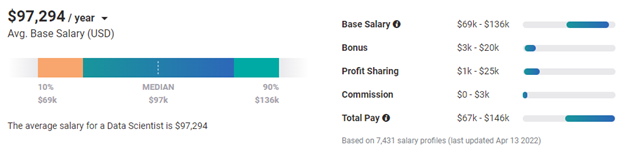
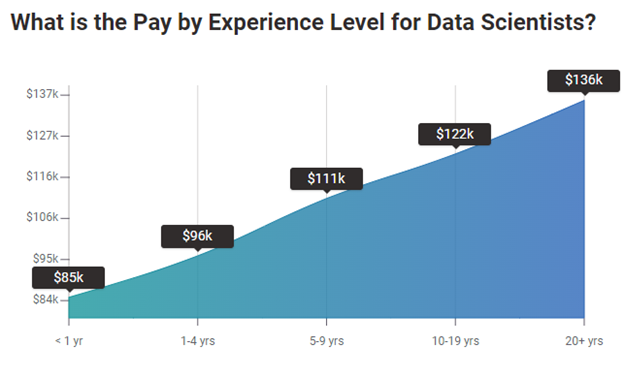
All stats and graphics point to one conclusion: data science is a well-paying field. Whether working at a big enterprise or a small startup, a data scientist is bound to return an above-average income.
Outlook
According to the Bureau of Labor Statistics US or BLS, 63,200 Data and Mathematical Scientists were employed in 2020, and 19,800 new jobs are projected from 2020 to 2030.
The vast numbers show rapid growth in the employment opportunities for Data Scientists, 31% to be exact. These stats are promising for anyone looking to pursue a career in data science or relevant fields.
Related careers
A Data Scientist has loads of career shift options. These include database administration, software development, computer network architecture, and information security analysis.
Any career that uses a Data Scientist’s ability to manage and process information could be an ideal career option.
Examples of the benefits of data science
Data science has revolutionized the way we see and deal with businesses. Here are a few practical implications of the technology:
- Accurate business decisions: A Data Scientist will produce and study accurate data that could lead a company to decide if to invest in a new product or not.
- Boost sales: Data science uses data-driven marketing to boost sales by identifying and advertising among target audiences.
- Data security: A business’s data can only be safe by an algorithm designed by data science.
- Automation: Data science can automate monotonous job routines like going through resumes.
- Data visualization: A visual representation of the market you are targeting can gain beneficial insights.
FAQs / Resources
1. How long does it take to become a Data Scientist?
A bachelor’s degree typically takes four years, and a master’s requires a year at least. After completing the formal education, you need at least 5 to 8 months to be proficient in data science.
2. How do I start a data science career?
A data science career usually starts with a bachelor’s and then an additional degree. Afterwards, an entry-level Data Analyst job can kick-start your career.
3. Is it hard to become a Data Scientist?
Just as any other field, data science requires extensive training, years of hard work, and persistence. You can become a Data Scientist in Australia through at least five years of education and considerable experience in a verified firm.
4. Which industry is best for data science?
The top industries catering to Data Scientists are:
- Health care
- Digital marketing
- Cybersecurity
- Retails
- Telecommunications
- Automotives